


1
/
of
5
Ifö Electric Sweden
Ifö Model 6080 Bernadotte Wall Lamps in Caramel Brown by Sigvard Bernadotte
Ifö Model 6080 Bernadotte Wall Lamps in Caramel Brown by Sigvard Bernadotte
Regular price
€260,00 EUR
Regular price
Sale price
€260,00 EUR
Taxes included.
Shipping calculated at checkout.
Quantity
Couldn't load pickup availability
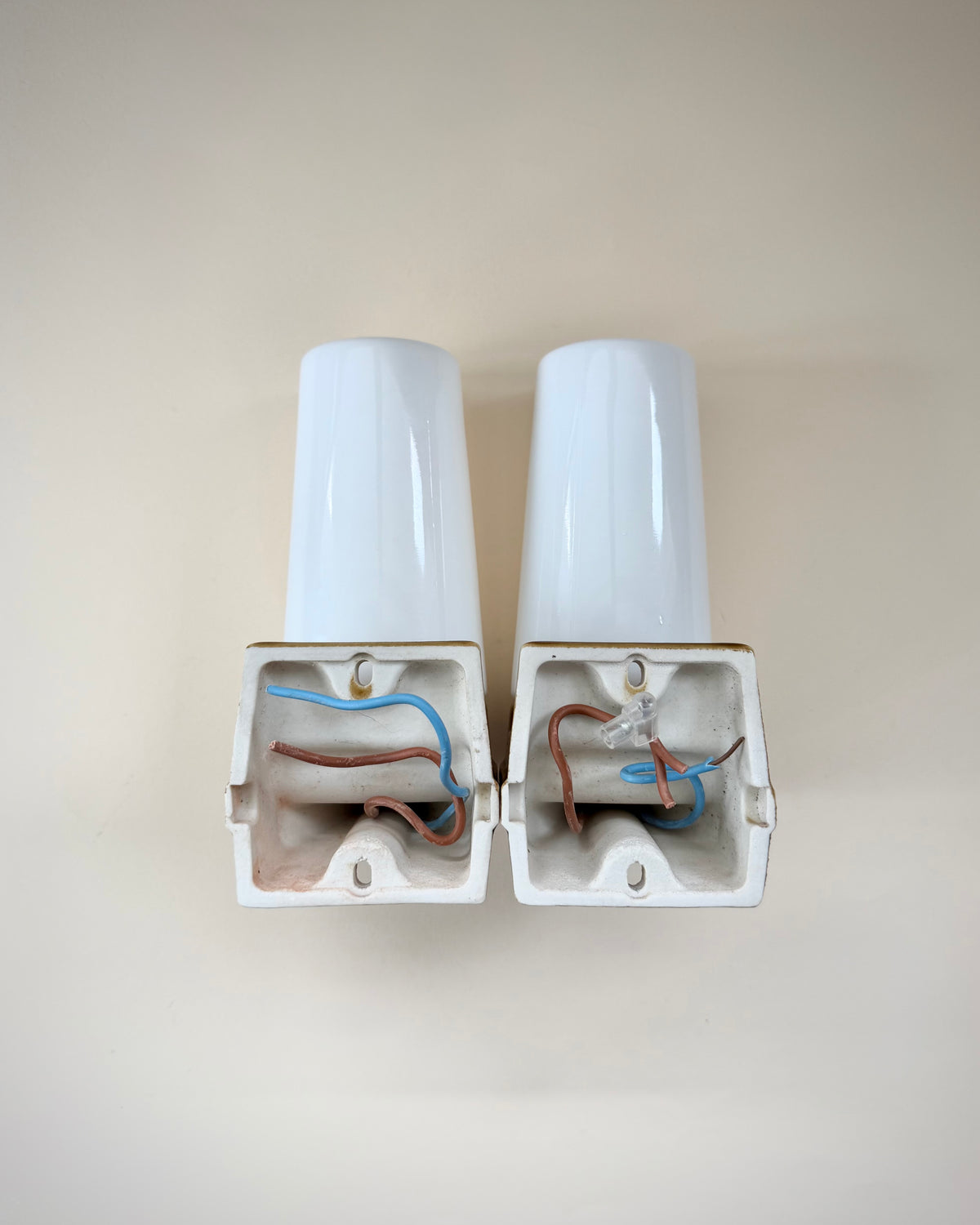
A pair of Model 6080 wall lamps designed by Sigvard Bernadotte for Ifö Electric in the mid-1960s. Each combines a compact ceramic body in a warm caramel-brown glaze with a cylindrical white opal glass shade.
Stepped geometric bases and softly rounded corners give the lamps an architectural presence, balanced by the simple vertical form of the glass. They can be mounted with the shades facing upwards or downwards, and the opal glass diffuses the light softly. This pair retains its original glazed ceramic bases and opal glass shades.
Share


Collapsible content
Story
About the Series: Bernadotte
The Bernadotte range was developed by Sigvard Bernadotte for Ifö during the 1960s, with a group of lighting designs that explored simple geometric forms in ceramic.
The pieces are built around a compact ceramic body with clearly defined planes and rounded transitions. Glazed surfaces add colour and depth without introducing additional ornament, while the opal glass shades provide a contrasting element of lightness.
The range included several types of lighting, allowing the same design language to appear in different settings and configurations. The combination of ceramic and opal glass is particularly characteristic of the collection, bringing together a solid, tactile material with a softer source of light.
The Bernadotte designs reflect an approach to lighting in which the fixture itself remains visually important even when it is not illuminated. Proportion, surface and the relationship between the ceramic body and the glass shade are central to the design.
About the Designer: Sigvard Bernadotte
Sigvard Bernadotte (1907–2002) was a Swedish designer and member of the Swedish royal family who developed an extensive career in industrial and graphic design.
After studying at the Royal Swedish Academy of Fine Arts in Stockholm, he moved towards applied design and established a studio working across several fields. His practice included household objects, silverware, textiles, graphics and industrial products.
Bernadotte was particularly interested in bringing greater precision and simplicity to objects made for everyday use. His designs often rely on clear geometry and carefully controlled proportions, with decoration reduced in favour of the form itself.
Throughout his career he collaborated with a wide range of manufacturers in Sweden and abroad. His work contributed to the development of a more modern Scandinavian approach to industrial design, in which everyday products could combine practical requirements with a strong visual identity.
About the Brand: Ifö
Ifö has its origins in southern Sweden, where the natural resources around the island of Ivö supported the development of an industrial ceramics and mineral-products company during the 20th century.
The company became particularly known for technical ceramics and electrical products. This expertise also made ceramic a natural material for lighting, where it could provide a robust body while allowing designers considerable freedom with shape and surface.
During the mid-century period, Ifö worked with designers to bring a more considered visual language to its electrical products. The resulting pieces combined the company’s industrial knowledge with the increasingly modern forms associated with Swedish design.
Ifö’s lighting production became especially well known for its ceramic fixtures, many of which have survived as examples of the meeting point between industrial manufacture and Scandinavian design.
The company continues to operate today, with its history still closely connected to electrical products and ceramic expertise.
The Bernadotte range was developed by Sigvard Bernadotte for Ifö during the 1960s, with a group of lighting designs that explored simple geometric forms in ceramic.
The pieces are built around a compact ceramic body with clearly defined planes and rounded transitions. Glazed surfaces add colour and depth without introducing additional ornament, while the opal glass shades provide a contrasting element of lightness.
The range included several types of lighting, allowing the same design language to appear in different settings and configurations. The combination of ceramic and opal glass is particularly characteristic of the collection, bringing together a solid, tactile material with a softer source of light.
The Bernadotte designs reflect an approach to lighting in which the fixture itself remains visually important even when it is not illuminated. Proportion, surface and the relationship between the ceramic body and the glass shade are central to the design.
About the Designer: Sigvard Bernadotte
Sigvard Bernadotte (1907–2002) was a Swedish designer and member of the Swedish royal family who developed an extensive career in industrial and graphic design.
After studying at the Royal Swedish Academy of Fine Arts in Stockholm, he moved towards applied design and established a studio working across several fields. His practice included household objects, silverware, textiles, graphics and industrial products.
Bernadotte was particularly interested in bringing greater precision and simplicity to objects made for everyday use. His designs often rely on clear geometry and carefully controlled proportions, with decoration reduced in favour of the form itself.
Throughout his career he collaborated with a wide range of manufacturers in Sweden and abroad. His work contributed to the development of a more modern Scandinavian approach to industrial design, in which everyday products could combine practical requirements with a strong visual identity.
About the Brand: Ifö
Ifö has its origins in southern Sweden, where the natural resources around the island of Ivö supported the development of an industrial ceramics and mineral-products company during the 20th century.
The company became particularly known for technical ceramics and electrical products. This expertise also made ceramic a natural material for lighting, where it could provide a robust body while allowing designers considerable freedom with shape and surface.
During the mid-century period, Ifö worked with designers to bring a more considered visual language to its electrical products. The resulting pieces combined the company’s industrial knowledge with the increasingly modern forms associated with Swedish design.
Ifö’s lighting production became especially well known for its ceramic fixtures, many of which have survived as examples of the meeting point between industrial manufacture and Scandinavian design.
The company continues to operate today, with its history still closely connected to electrical products and ceramic expertise.
Details
Origin: Sweden
Design Year: 1965
Production Period: 1960s–1970s
Designer: Sigvard Bernadotte
Manufacturer: Ifö Electric Sweden
Model: 6080
Series: Bernadotte
Material: Glazed porcelain and opal glass
Colour: Caramel brown and white
Components: 2 wall lamps
Dimensions: 18 cm H × 7.8 cm W × 10 cm D each
Electrical: Original wiring is present. Have the wiring and electrical components checked by a qualified electrician before installation and use.
Design Year: 1965
Production Period: 1960s–1970s
Designer: Sigvard Bernadotte
Manufacturer: Ifö Electric Sweden
Model: 6080
Series: Bernadotte
Material: Glazed porcelain and opal glass
Colour: Caramel brown and white
Components: 2 wall lamps
Dimensions: 18 cm H × 7.8 cm W × 10 cm D each
Electrical: Original wiring is present. Have the wiring and electrical components checked by a qualified electrician before installation and use.
Condition
Excellent vintage condition. The ceramic bases are intact, with the original glossy caramel-brown glaze well preserved and no chips or hairline cracks visible. The white opal glass shades are also in excellent condition, with clean threaded edges and no visible chips.
Care
Switch off and disconnect the lamps from the power supply before cleaning. Wipe the porcelain and opal glass with a soft, dry cloth. Have the original wiring and electrical components checked by a qualified electrician before installation and use.