


Iittala
Sointu Vase by Tapio Wirkkala for Iittala Finland
Sointu Vase by Tapio Wirkkala for Iittala Finland
Couldn't load pickup availability
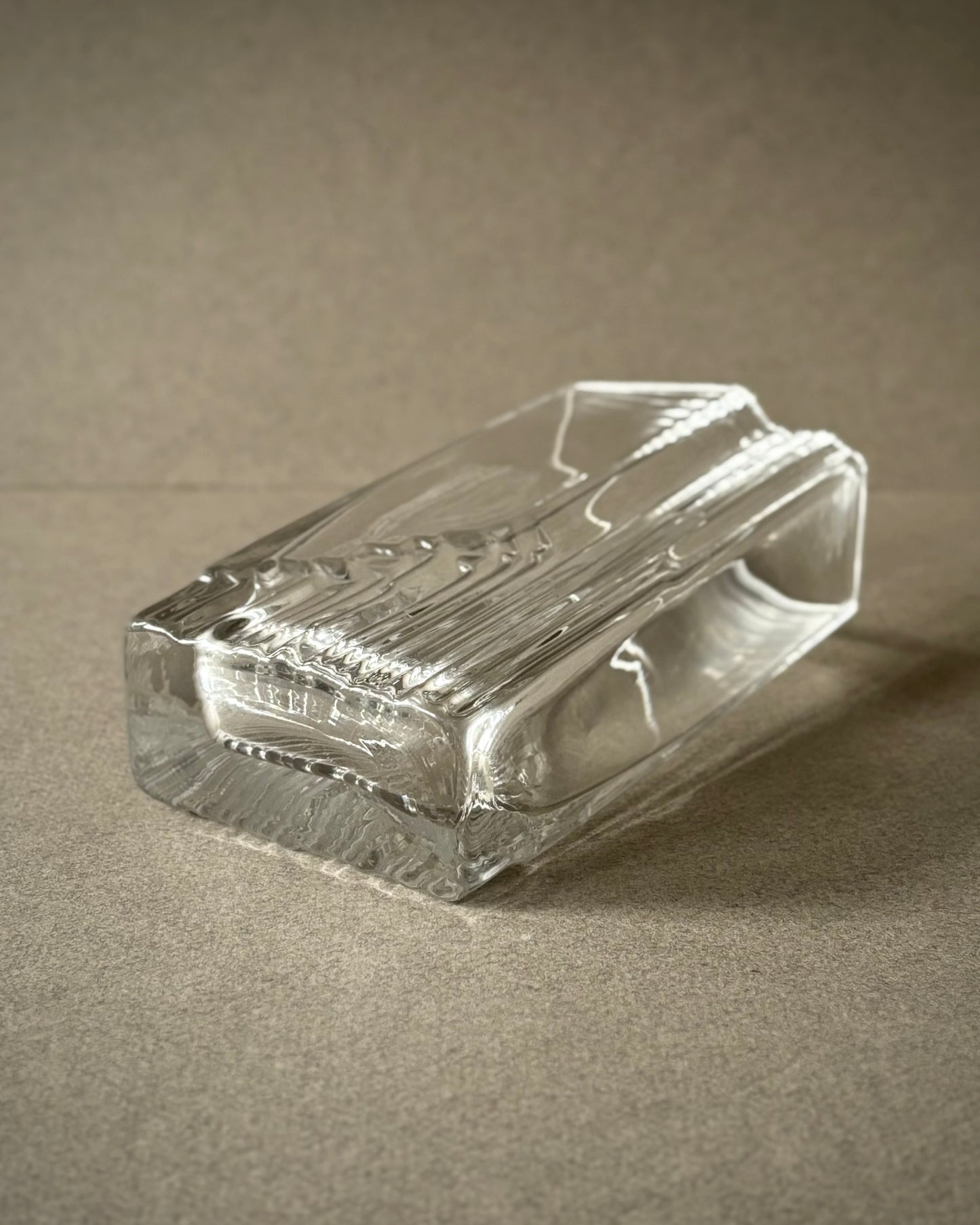
A Sointu vase designed by Tapio Wirkkala for Iittala, Finland, produced between 1979 and 1992. The name Sointu—meaning 'chord' or 'sound' in Finnish—reflects Wirkkala's poetic approach to design, where form and material create visual harmony. This hand-blown art glass vase embodies the master's signature exploration of organic textures inspired by Finland's natural landscape: ice formations, crystalline structures, and the interplay between rough and polished surfaces.
The Sointu vase features vertical ribbed textures that catch and refract light, creating dynamic shadow play throughout the day. The contrast between the textured exterior and smooth polished areas demonstrates Wirkkala's mastery of glass as both sculptural medium and functional object. The substantial weight and clarity of the hand-blown glass give the piece a commanding presence, whether displayed with flowers, branches, or as a standalone sculptural element.
This vase represents a pivotal moment in Finnish glass design when artists like Wirkkala elevated everyday objects into works of art, blurring the boundaries between craft, design, and fine art. The Sointu series exemplifies this philosophy—functional yet sculptural, minimal yet expressive, timeless yet distinctly Nordic.
Share


Collapsible content
Story
The Sointu series, designed by Tapio Wirkkala in 1979, represents a mature phase in the master's exploration of glass as sculptural material. The name "Sointu"—meaning "chord" or "sound" in Finnish—suggests the harmonic relationship between form, texture, and light that defines these pieces. Unlike earlier Wirkkala designs that often emphasized dramatic organic forms or bold textural experiments, Sointu achieves its impact through subtle contrasts and refined proportions.
The series features vertical ribbed textures that evoke natural phenomena—the striations in ice, the grain of wood, or the ripples in water—rendered with mathematical precision yet organic sensibility. This duality is quintessentially Wirkkala: the hand of nature interpreted through the discipline of design. The ribbing serves both aesthetic and functional purposes, catching and refracting light to create ever-changing visual effects while providing tactile interest and structural integrity.
Produced between 1979 and 1992, the Sointu series emerged during a period when Iittala was consolidating its position as a global design leader. By this time, Wirkkala had already achieved legendary status, and pieces like Sointu represented his continued commitment to innovation and refinement. The relatively short production run makes Sointu pieces less common than some of Wirkkala's earlier iconic designs, adding to their appeal among collectors who appreciate the later, more contemplative phase of his career.
About Tapio Wirkkala
Tapio Wirkkala (1915–1985) stands as one of the most influential figures in 20th-century design, not only in Finland but globally. His career spanned six decades and encompassed an extraordinary range of disciplines: glass, ceramics, wood, metal, industrial design, sculpture, and even banknote design. Wirkkala's genius lay in his ability to distill the essence of Finnish nature—its forests, lakes, ice, and geological formations—into objects of profound beauty and functionality.
Wirkkala's breakthrough came at the 1951 Milan Triennale, where he won three gold medals for his glass designs, catapulting Finnish design onto the international stage. Throughout the 1950s–70s, he continued to dominate the Triennales, earning a total of seven Grand Prix awards—a record that remains unmatched. His work for Iittala during this period produced some of the most iconic pieces in glass history, including the Kantarelli vase (1946), the Ultima Thule series (1968), and the Sointu series.
What distinguished Wirkkala from his contemporaries was his deep, almost spiritual connection to natural materials and forms. He would spend months studying ice formations on frozen lakes, the grain patterns in birch bark, or the erosion patterns in coastal rocks. This research informed his design vocabulary, resulting in pieces that feel simultaneously ancient and modern, organic yet precisely controlled. His glass pieces often feature contrasts—smooth against textured, transparent against opaque, geometric against organic—reflecting the dualities found in nature itself.
Wirkkala's influence extended beyond individual objects. He helped establish the Finnish design philosophy that beauty and utility are inseparable, that everyday objects deserve the same artistic consideration as fine art, and that design should be rooted in cultural identity while remaining universally accessible.
About Iittala
Founded in 1881 in the small Finnish village of Iittala, the glassworks began as a modest factory producing utilitarian glass objects. Over the following century, Iittala transformed into one of the world's most respected design houses, synonymous with Finnish design excellence and the broader Scandinavian modern movement.
Iittala's golden age began in the post-war period when the factory started collaborating with visionary designers like Alvar Aalto, Kaj Franck, Timo Sarpaneva, and Tapio Wirkkala. These partnerships produced objects that redefined what glass could be—not merely functional containers but expressions of cultural identity, artistic vision, and technical mastery. The factory's skilled glassblowers could execute the most demanding designs, translating artists' visions into reality through centuries-old techniques combined with modern innovation.
The Iittala philosophy centers on timeless design—objects meant to be used daily, passed down through generations, and appreciated for their enduring beauty rather than fleeting trends. This approach has resulted in many Iittala pieces remaining in continuous production for decades, while vintage pieces from the 1970s–90s have become highly collectible.
The Sointu vase represents this philosophy perfectly: a functional object elevated to art, a design rooted in Finnish nature yet universally appealing, a piece that works equally well in a contemporary minimalist interior or a traditional Nordic home. It embodies Iittala's commitment to quality, craftsmanship, and the belief that beautiful objects enrich daily life.
Details
Manufacturer: Iittala, Finland
Series: Sointu ("Chord" / "Sound")
Period: 1979–1992
Material: Hand-blown art glass
Technique: Artisanal glass blowing with textured ribbing and polished surfaces
Height: approx. 16 cm
Width: approx. 9 cm
Depth: approx. 5 cm
Weight: approx. 600 g
Quantity: 1 vase
Condition
Minor wear may be present. No cracks or chips. As with all vintage pieces, this vase may show signs of previous use and age. Any such marks are signs of authenticity, not flaws, and add to its unique character.